The Intrepid Student and the First Englishman

The pandemic has resurfaced to my view an unlikely life, someone I met in North India 25 years ago.

India’s sights, sounds and smells overwhelm a first-time visitor from the West. On my initial trip, 1995, everywhere I looked riveted my attention, especially the sheer numbers of people—children, women and men in south Asian dress doing interesting things.
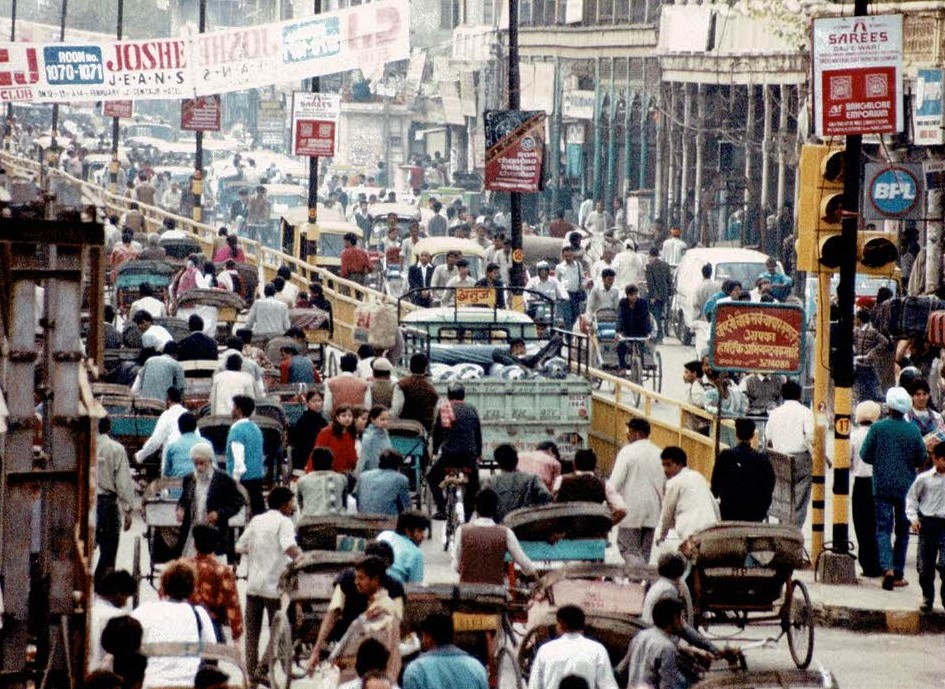
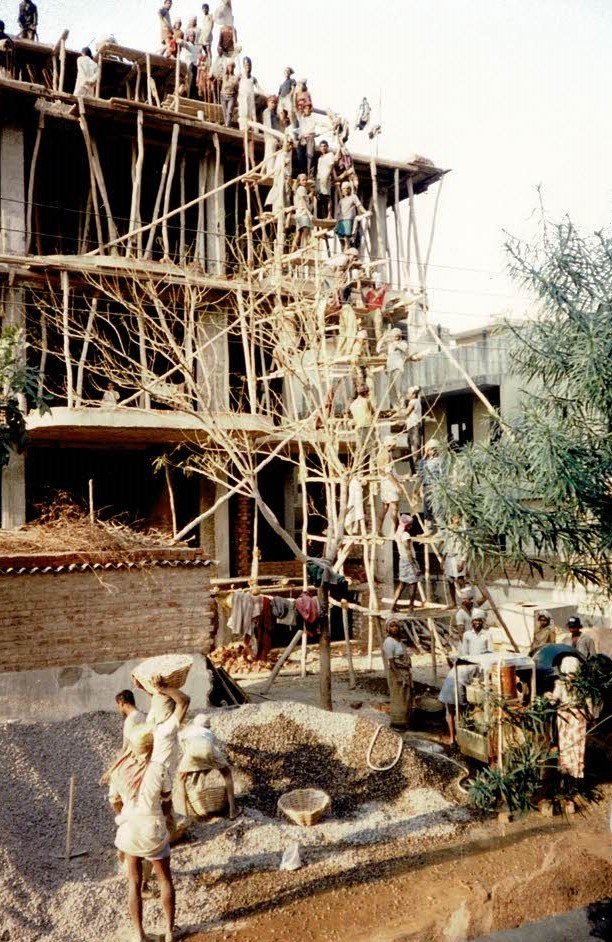
Cars, buses, trucks, human-powered rickshaws, scooters, oxen-drawn wagons, bicycles … a tangle of vehicles snarled the roadway as pedestrians darted through the gaps with care. Trucks bore strange signs at the back: “Honk, please.” Pairs of laborers stood on rickety, ascending platforms passing cement-loaded trays up three stories of a construction project. Cattle tethered on short leashes languished beside tiny homes lining narrow, dusty streets.
Of course India boasts lots of world-class tourist sites, especially the Taj Mahal, and a list of lesser-known Mughal architectural wonders including the Red Fort and Fatehpur Sikri, all splendid, enchanting, spectacular.

But the people, the God-image bearers, made the deepest impression. One, especially.

My agency had sent me to observe a church-leadership training seminar, a three-day affair hosted by Baring Union Christian College in Batala, Punjab, a city of over 100,000. The teaching was conducted in Hindi, one of India’s 14 official languages, 13 of which I spoke equally well (which is to say, except for English, not at all).

One can abide incomprehensible speech only so long before restlessness overcomes patience, and so it was, a couple of hours into the session, that I slipped outside for a look around. And because I did, my life is richer 25 years later.

Swept up in a crowd

Following the assassination of Prime Minister Indira Ghandi by Sikhs in 1985, Punjab state, home of the Sikhs, had been closed to foreign travel until a few years before my visit. A Westerner was a rare commodity in Batala in 1995. I didn’t know this; it might have prepared me for what was about to happen.

I walked a few steps from the seminar room and came to a ten-acre lawn dotted with clusters of students segregated by sex; groups of guys, bunches of girls. I greeted someone and a throng of young men quickly formed around me, pressed in on me. From where have you come? What is it like in America? What are you thinking about India? Other questions followed, some not suitable to publish but unsurprising considering that young men everywhere are interested in “the way of a man with a maid,” as Agur put it, and perceive Americans as experts in such matters.
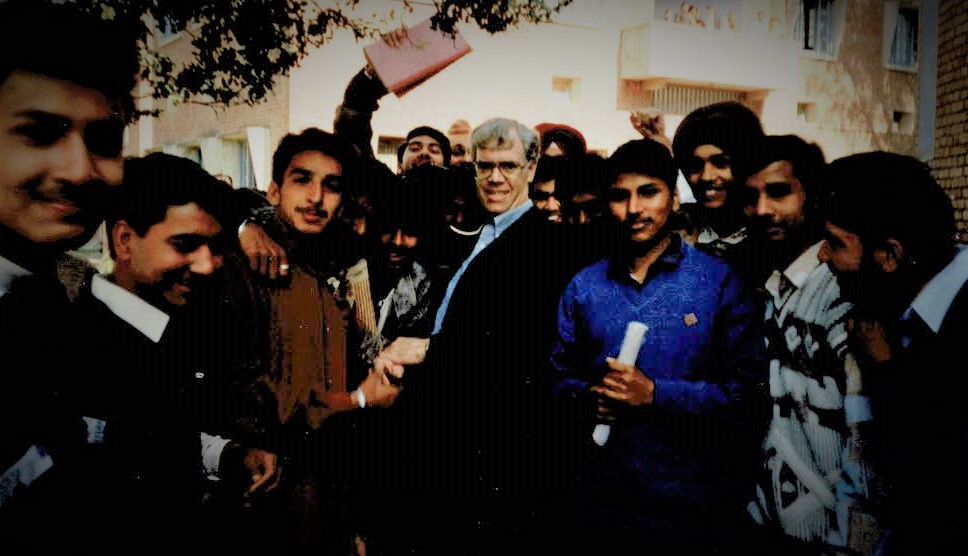
Any opportunity for meaningful conversation quickly dissolved as I started to answer a question only to be interrupted by another shouted from the edges of the crowd as additional students joined the fray. It occurred to me what Mark the gospeler meant, “Jesus could no longer openly enter a town, but was out in desolate places, and people were coming to him from every quarter.” It was a rush, but wanting to avoid a spectacle, I had started moving away, when one young man stepped up with a direct request. Could I meet with him later to talk? We agreed on a time and place, and I returned to the seminar.

One courageous invitation

At the appointed time I found the rooftop of a three-story building where my supplicant, Ashwani, and two friends waited. “Will you come to my village?” he immediately asked.

“How far is it?” I envisioned a journey my schedule would not allow, but he assured me a twenty-minute rickshaw ride would get us there. I secured permission from my host and it was set. We left the campus by bicycle rickshaw, stopped to meet his father selling shoes by the road, and again to have tea with his friend minding a wedding-supply shop, before arriving at an agricultural hamlet on the edge of the city.

Children encircled us as we walked into the community along the narrow street between houses. One young man took my hand to walk beside me. I was perplexed by the energy and celebratory spirit. Ashwani saw that on my countenance. “You must understand, sir. You are the first Englishman to visit my village.”
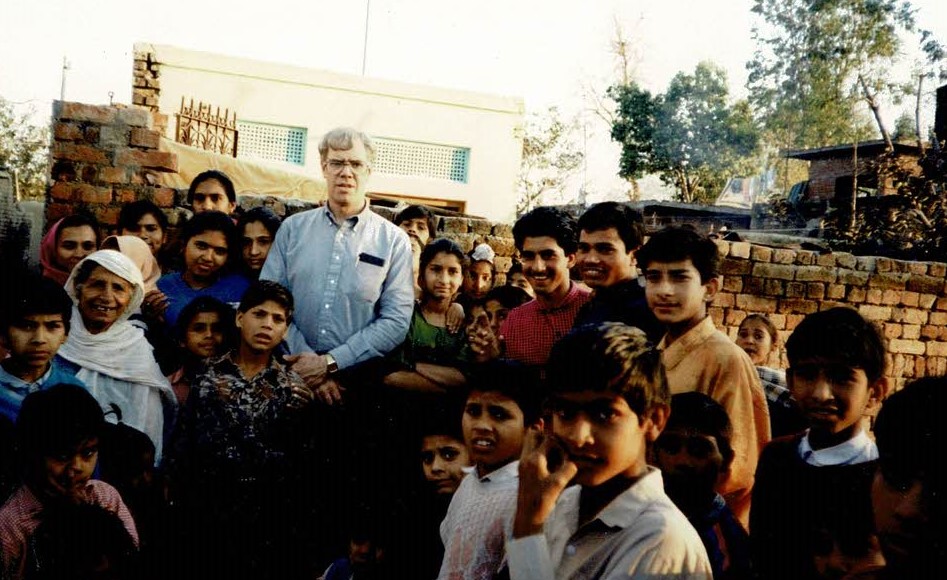
Ashwani’s neighbors blessed him for his initiative to deliver joy to an ordinary day. As for the “Englishman,” he was having an out-of-body experience. Every household fed me. Ashwani offered milk, a food I had been warned to avoid, but it arrived in a gleaming stainless steel tumbler, sweet and pure and delicious. These rural villagers on the outskirts of Batala provided astonishing hospitality to a stranger. To recount it in detail would overrun my readers’ patience, perhaps.

Okay, one detail. I had just finished telling the story of David and Goliath to the assembled children when Ashwani quietly inquired, “Sir, would you like a comb? Your hairs are scattered!” I still smile at that memory, but the fact is, he cared about my dignity enough to risk my disapproval. Only selfless love overcomes fear of rejection.

God uses unlikely people

Good deeds often come from unlikely sources. Seven thousand miles and 25 years have not erased the impact of that day (and the next, when Ashwani approached me on the campus begging me to return, “Those who did not see you are considered unlucky.”) All this wonder, both for the hamlet and the visitor, was made possible by a student’s courage to approach a foreigner on behalf of his community, a stranger whose only meaningful credential was his place of birth.

And after I returned home, Ashwani wrote me repeatedly, even spent precious rupees to call me on several occasions. Sometimes, when he couldn’t muster enough cash to call, he would dial my number and hang up after one ring, somehow reassured by the mental image of his “Englishman” friend on the other side of the world holding a phone and thinking about him, and his village beside Batala.

Over the intervening years, the calls and cards diminished and almost stopped. Time and responsibilities intervened. Ashwani graduated, got a teaching job, married, sired two children.

But in September 2001, when the towers fell three thousand miles from me, he called to be sure I was okay.

And earlier this month, Ashwani phoned to check on my welfare in the pandemic. From his native land, where day laborers are starving in the Covid storm, he reached across the Pacific once again to be sure I was okay.

When we think we’re too small and insignificant to be of much use, we need to remember Ashwani. He scorned intimidation and risked rejection to extend himself into the life of another, and a little bit of history was created as a result.


The Fisherman on the Aisle Was Listening

Last July I wrote about a most remarkable experience in the Seoul, Korea airport. This post relates a different encounter in another airport, Sea-Tac, in Washington state.

In the 90s I traveled between Oregon and Alaska two or three times a year. Almost always I took the (cheaper) late flight from PDX to Anchorage, arriving about 1 a.m. And, on the way home, the red-eye.

One of those 2 a.m. departures from Anchorage found me by the window, and, in the middle seat next to me, a young man, a little rough around the edges. Unwashed, I think. I figured he was a commuting fishermen. Lots of commercial fishers traveled between Alaska and the Pacific NW.

He seemed grumpy (turned out he wasn’t feeling well) and I was tired. I didn’t want to talk. But I felt compelled (later I knew it wasn’t just an intrinsic compulsion; Someone was compelling me) to start a conversation in an effort to share the gospel. I could never have imagined what the Holy Spirit was up to, but I was about to find out.

He freely shared about his life. Yes, he was a fisherman. The only other thing I remember: his uncle was a preacher. That provided a natural segue to my testimony, and the gospel. He listened politely, interacted a little, but wasn’t interested. I tried to be clear that his eternal destiny was at stake, and what it meant to trust Christ. I asked him if he wouldn’t like to do that right there. But he wasn’t ready.

We stopped talking, I turned to the window, went to sleep and didn’t wake until Seattle.

I thought I was going for a walk

The plane was going on to Portland; there was no need to get off. But I wanted to stretch my legs. Again, I could not know I was being nudged by Providence.

At the gate desk I inquired how long before reboarding. “About ten minutes.” I turned to start a brisk walk, but someone was there, waiting for me, the man who’d been in the aisle seat in my row, on the other side of the fisherman. A young guy, maybe 25. He wanted to talk. He seemed agitated. And he surprised me.

“I heard you talking to that man sitting between us and I think you’re a very fortunate guy.” He fidgeted. I wondered if he was going to hit me. I was lucky because the other guy didn’t hit me, but this fellow was going to do it. (You know how your mind can run away in a flash?)

“I’ve never met anyone who was so confident about their relationship with God.” He pulled a scrap of paper from his pocket and pushed it at me. “I heard you tell him you’d send him some information and I was wondering if … maybe … you’d …”

I took the slip. He’d scrawled his name and address.

“Of course I’d be happy to send you the same material.” He nodded. “In fact, we can talk right now. I’ve got time before I have to get back on the plane.”

“Oh no, my life is such a mess.” He looked away, then back. Talked some more. He also was a commercial fisherman, on his way home to North Dakota. He’d recently broken up with his girl, and when he stepped off the plane and saw couples embracing, the pain rushed over him again.

“Why don’t we just sit down and talk for a few minutes? I could pray with you.”

Not just  a couple of guys talking

No, he didn’t think so. But he kept talking. Told me about a friend who’d been killed in a car accident. Hurt and grief went deep in him. He figured he’d just go now. He wasn’t worthy to ask anything from God.

Once more, I invited him. “Why don’t we just sit down over here and talk about it? You can respond to God right now.”

No, he guessed not. And I almost gave up. No point in being obnoxious. Just as well start that walk.

Then it hit me. I realized what was happening. This wasn’t just a human encounter, a couple of weary travelers chatting at six in the morning in a busy airport. For just a moment, time had stopped. Heaven and hell were in attendance, one beckoning, one grasping. This young man in front of me was standing at Jesus’ door, and about to turn away. This was his moment. Jesus was calling, and the devil was lying.

“You know, there’s a battle going on right now.”

“Yeah, I know. I’ve really messed up.”

“No, I don’t think you understand. Someone is whispering in your ear right now, ‘Get away from this guy. Don’t listen to him. Get out of here.’ And you could do that. You could end this conversation and walk away. But you might never be in this place in your life again. God is calling to you. Are you sure you won’t step over here with me and look at the Bible and pray?”

“Okay.”

What I almost missed out on

We found a spot about as quiet as you could expect and read some Bible verses. Why we need a savior, and who he is, and how do we come into relationship with him. We are great sinners, but Christ is a great Savior. He could never be good enough to please God, but Jesus’ perfect goodness had been offered to God on his behalf.

And there, at 6:00 a.m. in the Seattle airport, a fisherman bowed and repented and trusted in the promise of Christ. He prayed. Right there at a SeaTac gate, people coming and going, he found faith in Jesus. He’d almost walked away, but he stayed and was born again by the Spirit of God.

I got home and mailed the material, and included the name of a church or two in his town. Never heard back. Reckon I’ll see him at Jesus’ feet someday.

He almost missed his moment, and so did I. When I had boarded in Alaska, I didn’t feel like talking to anyone. I just wanted to sleep. But something—Someone, actually—constrained me to speak to my neighbor. I did, he heard, said No. Which didn’t surprise me. That was normal.

But the message wasn’t meant for him. The fisherman in the middle was tuned out, but the fisherman on the aisle was listening. I didn’t know that, might have wondered, after that “fruitless” conversation, What was that all about, Lord? I could not have known for whom the words were spoken.

And while I slept, an eavesdropping passenger pondered and processed. And got off the plane, and waited, just in case I showed up.

It’s a great example of the difference between the gospel call and the effectual call. But that’s for another post.

The Woman Who Trusted God in Affliction

When I was 12 I met Amanda Friesen. Fifty-four years later the image of her broken body remains vivid in my mind.

Amanda’s life defined victory in affliction. Not just coping, but flourishing in the most severe circumstances.

I have thought about her these days as so many friends are suffering. Barb’s 22-year-old grandson is dying of cancer. Angie’s good friend the same. Susan must bury her husband of 51 years. Mary is losing her baby, a little bit at a time, before he saw the light of day. Some unnamed degenerative malady is ripping Carol’s body. Clark is bewildered, trying to find his footing in retirement after a lifetime of ministry here and abroad. (Not their real names.) All these remind me of Amanda.

Most of my story at 12 has faded from memory. It was small-town life in America’s heartland. We rode our bikes all over town till sundown and played kick the can after dark. We hunted rabbits on the Woodruff farm above the Niobrara River and ate fried chicken on Sunday. Some would call it dull, our farming community of a few hundred souls. Not much memorable material to blog about.

But I remember Jake and Amanda Friesen. They lived in Fairfax, South Dakota, ten miles north across the state line. Jake was a schoolteacher, unreremarkable to my view. Tall and thin are the only descriptors I can recover.

As for Amanda, nobody could forget the first time they saw her. And I’m not talking about glamour.

No visible beauty

She was likely never glamorous: of sound prairie Mennonite stock, after all. But an enchanting, demure lass looks at me from the portrait in her book of poetry. Her high school grad picture, maybe? An attractive young woman of the Roaring Twenties: dark wavy hair, gentle eyes behind frameless glasses, slight smile flanked by a dimple; this Amanda I never met.

After that picture she married, and lost one baby before three others arrived. Inside a dozen years after the last birth, a crippling arthritis took her, mutated her into the Amanda I remember: pale skin; thin, gray hair; body rigid as wood.

Webster defines paralysis: “the loss of the power of muscular motion, or of the command of the muscles.” Gary Brumbelow defined it, for many years: “stiff like a board.” Forever stamped in my memory is the strange sight of Jake carrying her from his station wagon, as one might move a mannequin, into our house. Dad folded down the piano, and Jake laid her on it. She could move her arms from the elbows down, her eyes and her mouth. That’s all. She wore prism glasses that bent her sight 90 degrees, and used a mirror to look at us and join the conversation as we ate and talked around the table beside her.

The paralysis never beat her

One time I was in their home and saw her ironing. She was strapped to a vertical “bed” Jake had fashioned that allowed her to move an iron back and forth over the laundry. That hideous arthritis had crippled but not beaten her. “Struck down, but not destroyed.”

Jesus loved Amanda and she loved him back. Her gracious words uplifted all who came to her, including my mom. She spoke of a healing she knew was coming. I doubted that very much, but said nothing, of course. I regarded such talk as wishful thinking, didn’t realize till much later she was talking about the resurrection.

In her affliction, Amanda Friesen overflowed with joy. She had confidence to spare. In her poems she writes about “the Book of books” which she loved to read. I suspect she knew Paul’s prayer for the Ephesians.

I pray that you, being rooted and grounded in love, may have strength to comprehend with all the saints what is the breadth and length and height and depth, and to know the love of Christ that surpasses knowledge, that you may be filled with all the fullness of God. (Eph 3:18-19 ESV)

Strong enough to grasp Jesus’ love

Paul did not ask God to remove the Ephesians’ affliction. He did not ask Him to give them strength to bear their suffering, or wisdom to understand God’s purposes. This we might have expected. He asks God to make them strong enough to comprehend how big Jesus’ love is. A four-dimension love, one that is never diminished, so that regardless of our circumstances, no matter how severe our suffering, we can simply rest. Can live in peace. Even when a grandson dies at 22, a baby is lost, a loved one robbed by ALS. 

Because God is always good. He makes no mistakes. Upon a day to come we will see the tapestry from the front that we now regard only from the back, its seemingly random threads weaving doubt where faith should prevail. As it did for Amanda.

Cat On a Pole

We’d been in Williams Lake, British Columbia less than a month when we had an unlikely encounter with a cat, an experience which pictures the contrast between God’s glory and human glory. This post wraps up a three-part series which began with What Do You Say to a Weeping Stranger.

Home was a 12×50 foot trailer we had hauled 2300 miles from Nebraska. We installed it at the Kendall Acres mobile home park high above the town. Our assignment—Alkali Lake Reserve—lay forty miles south on the Dog Creek Road. Two or three times a week we spent an hour each way bumping over gravel roads that exacted revenge on our 1972 Olds Cutlass for the pounding of log trucks.

One November day we were maybe a mile from home, weaving the curvy road between homesteads and small farms cut out of the woods, when we rounded another bend and spotted a cat perched at the top of a utility pole. When we returned a couple of hours later the feline was still there. And still there two or three days later when we set out for Alkali again.

Williams Lake is 200 miles north of the border. November in Williams Lake is like January in Wichita–near freezing. Something had to be done.

The firefighter who answered my call to the fire station rebuffed my request. The cat would come down when it was ready. But we weren’t convinced, decided to attempt a rescue with our own resources.

How do you get a cat off a pole?

I scrummaged a short piece of lightweight pipe, wire and rope. At the scene, I cut a sapling long enough to reach the cat. To its smaller end I lashed the pipe with the wire, pushed a loop of rope through the pipe from the bottom, and tied the short end of the rope to the pole below the pipe. The long end hung free.

We heaved the pole to the cat. After several tries I snagged the body of the cat with the loop, pulled it snug, and tugged the creature from its perch. That pull set the high end of pole, feline attached, into an arc, which made it impossible to slow the cat’s descent. It hit the ground a little hard, but unhurt. We rushed to free her from the rope.

What does a cat do in such a situation? Dash for the woods, of course. That’s what I expected. But I was wrong. As soon as the rope was off, that feline plastered herself against my ankles, rubbing and purring to show her gratitude. In fact she insisted on going home with us and hung around for about 24 hours before moving on.

The cat’s response surprised me. I’ve thought about it many times–a fun experience and fun story.

But not as fun as the Seoul story. And that story is not as amazing as God’s cosmic rescue of His elect, including Gary Brumbelow. Less amazing in at least four ways.

God, the original hero

God gave us the privilege of helping the Russian family; however, anyone could have done it. … But only God could rescue a lost world.

We rescued them from a temporary difficulty. I don’t know what would have happened, but the consequences would not have been eternal. … Which is exactly what the consequences are in the cosmic rescue God effected for lost sinners.

We spent little to help these strangers from Russia–about 30 minutes of our time and not enough calories to measure. … But God gave his beloved Son; Jesus laid down his life for our rescue.

Finally, the Russian woman and her family were strangers. … But “God showed his love for us in that while we were enemies, Christ died for us.” (Romans 5:8)

That’s enough fodder to ponder for a long time. And, beyond time, forever. Praise be to God.