
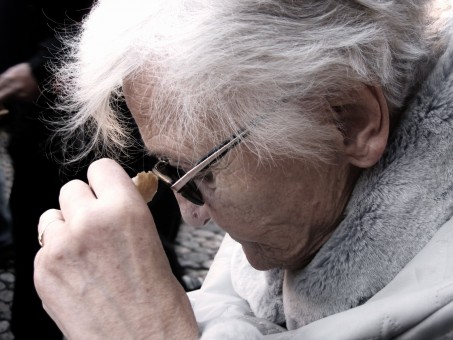
When I was 12 I met Amanda Friesen. Fifty-four years later the image of her broken body remains vivid in my mind.
Amanda’s life defined victory in affliction. Not just coping, but flourishing in the most severe circumstances.
I have thought about her these days as so many friends are suffering. Barb’s 22-year-old grandson is dying of cancer. Angie’s good friend the same. Susan must bury her husband of 51 years. Mary is losing her baby, a little bit at a time, before he saw the light of day. Some unnamed degenerative malady is ripping Carol’s body. Clark is bewildered, trying to find his footing in retirement after a lifetime of ministry here and abroad. (Not their real names.) All these remind me of Amanda.
Most of my story at 12 has faded from memory. It was small-town life in  America’s heartland. We rode our bikes all over town till sundown and played kick the can after dark. We hunted rabbits on the Woodruff farm above the Niobrara River and ate fried chicken on Sunday. Some would call it dull, our farming community of a few hundred souls. Not much memorable material to blog about.
But I remember Jake and Amanda Friesen. They lived in Fairfax, South Dakota, ten miles north across the state line. Jake was a schoolteacher, unreremarkable to my view. Tall and thin are the only descriptors I can recover.
As for Amanda, nobody could forget the first time they saw her. And I’m not talking about glamour.
No visible beauty
She was likely never glamorous: of sound prairie Mennonite stock, after all. But an enchanting, demure lass looks at me from the portrait in her book of poetry. Her high school grad picture, maybe? An attractive young woman of the Roaring Twenties: dark wavy hair, gentle eyes behind frameless glasses, slight smile flanked by a dimple; this Amanda I never met.
After that picture she married, and lost one baby before three others arrived. Inside a dozen years after the last birth, a crippling arthritis took her, mutated her into the Amanda I remember: pale skin; thin, gray hair; body rigid as wood.
Webster defines paralysis: “the loss of the power of muscular motion, or of the command of the muscles.” Gary Brumbelow defined it, for many years: “stiff like a board.” Forever stamped in my memory is the strange sight of Jake carrying her from his station wagon, as one might move a mannequin, into our house. Dad folded down the piano, and Jake laid her on it. She could move her arms from the elbows down, her eyes and her mouth. That’s all. She wore prism glasses that bent her sight 90 degrees, and used a mirror to look at us and join the conversation as we ate and talked around the table beside her.
The paralysis never beat her
One time I was in their home and saw her ironing. She was strapped to a vertical “bed” Jake had fashioned that allowed her to move an iron back and forth over the laundry. That hideous arthritis had crippled but not beaten her. “Struck down, but not destroyed.”
 Jesus loved Amanda and she loved him back. Her gracious words uplifted all who came to her, including my mom. She spoke of a healing she knew was coming. I doubted that very much, but said nothing, of course. I regarded such talk as wishful thinking, didn’t realize till much later she was talking about the resurrection.
In her affliction, Amanda Friesen overflowed with joy. She had confidence to spare. In her poems she writes about “the Book of books” which she loved to read. I suspect she knew Paul’s prayer for the Ephesians.
I pray … that you, being rooted and grounded in love, may have strength to comprehend with all the saints what is the breadth and length and height and depth, and to know the love of Christ that surpasses knowledge, that you may be filled with all the fullness of God. (Eph 3:18-19 ESV)
Strong enough to grasp Jesus’ love
Paul did not ask God to remove the Ephesians’ affliction. He did not ask Him to give them strength to bear their suffering, or wisdom to understand God’s purposes. This we might have expected. He asks God to make them strong enough to comprehend how big Jesus’ love is. A four-dimension love, one that is never diminished, so that regardless of our circumstances, no matter how severe our suffering, we can simply rest. Can live in peace. Even when a grandson dies at 22, a baby is lost, a loved one robbed by ALS.
Because God is always good. He makes no mistakes. Upon a day to come we will see the tapestry from the front that we now regard only from the back, its seemingly random threads weaving doubt where faith should prevail. As it did for Amanda.
 ek Road. Two or three times a week we spent an hour each way bumping over gravel roads that exacted revenge on our 1972 Olds Cutlass for the pounding of log trucks.
 what I expected. But I was wrong. As soon as the rope was off, that feline plastered herself against my ankles, rubbing and purring to show her gratitude. In fact she insisted on going home with us and hung around for about 24 hours before moving on.

 We’ve received much from God. Ephesians 1:3-14 lists multiple benefits God has granted us in Christ: election, predestination, adoption, redemption, forgiveness, and more. And as the writer lists these blessings, he interrupts himself three times with an intriguing phrase: “to the praise of the glory of His grace” (v 6); “to the praise of His glory (v 12); “to the praise of His glory” (v 14).