
My wife and I recently read Rocket Men: the daring odyssey of Apollo 8 and the astronauts who made man’s first journey to the moon, by Robert Kurson. (Thanks, Mark Moffat, for the tip!)
Page 282 describes the astronauts, on their way home, crossing the point “at which Earth’s gravity [becomes] dominant.” From there the spaceship gradually accelerated until, days later, entering the earth’s atmosphere, they topped out at 24,500 mph.
“But that was a long way off,” Kurson writes, “and for now, when the crew looked out their windows, with no landmarks in sight, they seemed to be standing still.” That was an illusion. They were not motionless, they were flying at 5,720 mph.
“A good metaphor for life,” my wife said when she came to that page. Sometimes it feels like you’re stuck when you’re actually flying. Maybe you’ve had seasons like that.
Baby bird from America
In 1993, I spent two weeks in Ukraine teaching Cross-Cultural Communication of the Gospel at Donetsk Christian University, invited by Dr. Ray Prigodich, DCU academic dean at the time. It was my first overseas trip—after fifteen years as a missionary long overdue—and full of wonder and worry: the wonder of a foreign culture, the worry of a new assignment. My classroom skills were limited, my experience even less.
Sixty students from various parts of the former Soviet Union studied at DCU, preparing f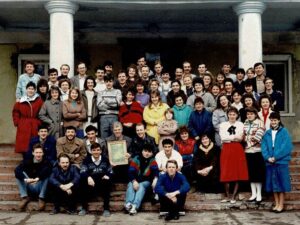 or ministry in some part of the Slavic world. I had spent many hours writing curriculum for ten days of class. My arrival coincided with the Sunday morning service on campus, followed by some time to rest. But Monday morning, and the first class session, was soon upon me. Like a baby robin contemplating gravity from the nest, I stepped off the edge and furiously flapped my lecturer wings, hoping not to crash.
And actually, it wasn’t so bad … at first. Class all morning, and prep in the afternoon. Two competent interpreters swapped off sessions. The students engaged in the class discussions and one-on-one with me during breaks.
As with many test flights, this one started with a lift and gradually glided earthward. By the end of the first week, my pinions hung a little ragged. Felt pretty much grounded. The initial enthusiasm waned, and by the last couple of days I was consoling myself: “You did not meet your expectations, and surely disappointed the students, but you did your best.”
Surprise awaited
With that self solace I came to the last day, determined to stick the thing out with a brave face, finish with what strength I could muster. That afternoon I would fly to Kiev and be driven to Rovno, a city in western Ukraine, to spend the weekend with national church leaders before departing for Oregon and home.
But, on that last day of class, I was in for a surprise.
As I wrapped up a little before noon, a student asked for the floor. Speaking for the group, he said they wanted me to know how much they had appreciated their time with me. They had found encouragement in my smile and friendly manner, learned from the material. Other warm remarks followed, words I have since forgotten.
They gifted me with a painting one of the young ladies had completed  during those two weeks, a garden scene in oil. On the back, in neat Cyrillic, someone had written, “With fond memories to the dear professor from the students of the Bible College, 3/11/93.” In the group picture I’m holding the painting. “The Garden” hangs in our home, and twenty-seven years later the memory warms me.
I thought about this when my wife recognized the metaphor in the Apollo 8 story, three lunar explorers feeling motionless while traveling seven times the speed of sound. Rocket men, them; me, a little bird. Different leagues, but neither felt movement.
But One is always working
Such has ever been the human story. Abraham waited twenty-five years on God’s promise of offspring with no indication anything was happening.
Joseph thought he was stuck in Pharaoh’s prison but found out otherwise.
And how about Moses’ forty years in the desert, the very definition of high and dry? But God was moving things along at exactly the right speed.
Humans were born to produce, to see progress. That those rocket men could endure hours, maybe days, without any sensation of motion testifies to the stuff of which such voyagers are made. Most of us have far lower thresholds of discipline.
Stuckness … and that’s one way to describe 2020 … wears on the soul. We ache for light, motion, progress, some assurance of the dawn. And our soul’s Mover and Shaker whispers, “Take courage, you are not abandoned.”
“He does not withhold His grace from those who earnestly ask for it,” Brother Lawrence wrote in 1691. “Knock on His door, and keep on knocking and I assure you that if you are not discouraged, He will open it in His own good time and give you all at once what He has withheld for years.”
Imagine that.

 dia’s sights, sounds and smells overwhelm a first-time visitor from the West. On my initial trip, 1995, everywhere I looked riveted my attention, especially the sheer numbers of people—children, women and men in south Asian dress doing interesting things.
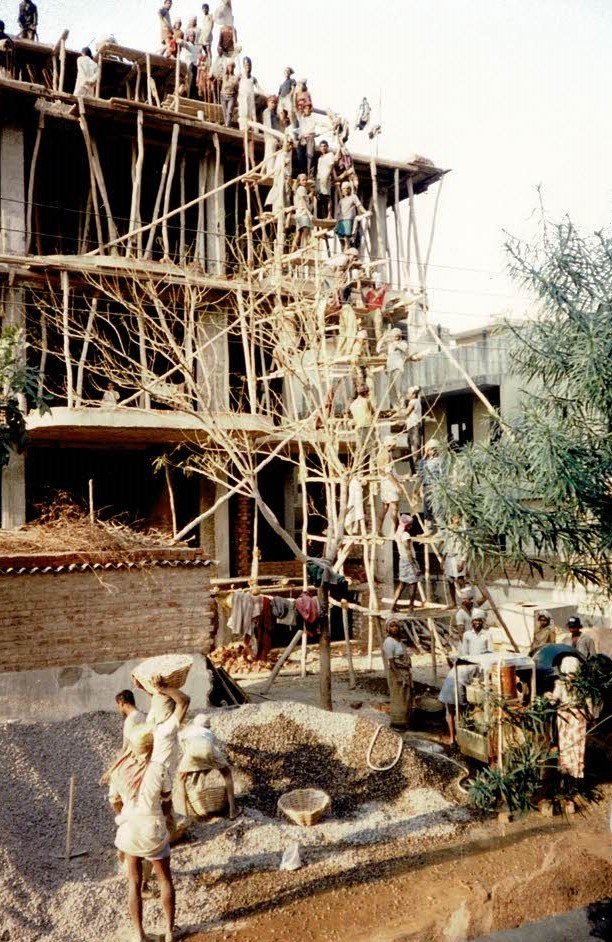 “Honk, please.” Pairs of laborers stood on rickety, ascending platforms passing cement-loaded trays up three stories of a construction project. Cattle tethered on short leashes languished beside tiny homes lining narrow, dusty streets.
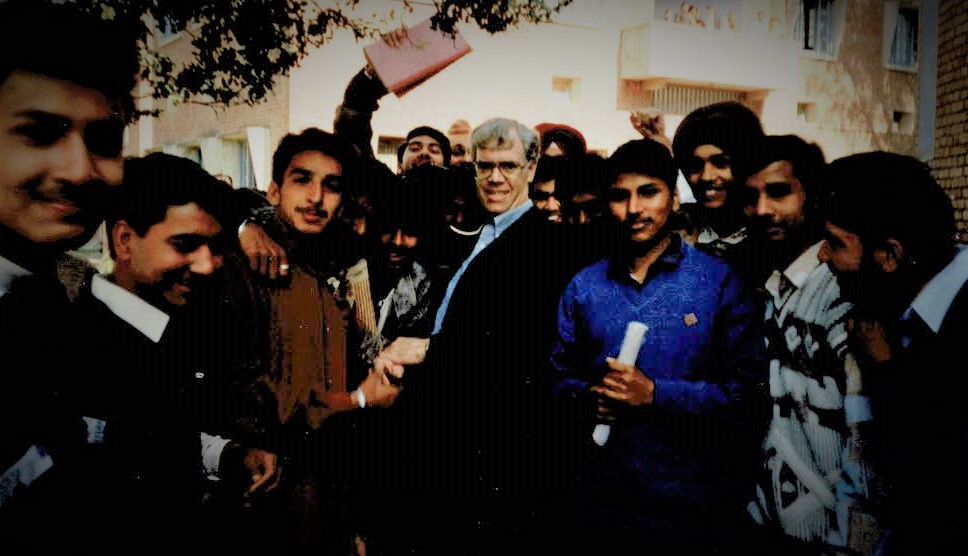 dotted with clusters of students segregated by sex; groups of guys, bunches of girls. I greeted someone and a throng of young men quickly formed around me, pressed in on me. From where have you come? What is it like in America? What are you thinking about India? Other questions followed, some not suitable to publish but unsurprising considering that young men everywhere are interested in “the way of a man with a maid,” as Agur put it, and perceive Americans as experts in such matters.
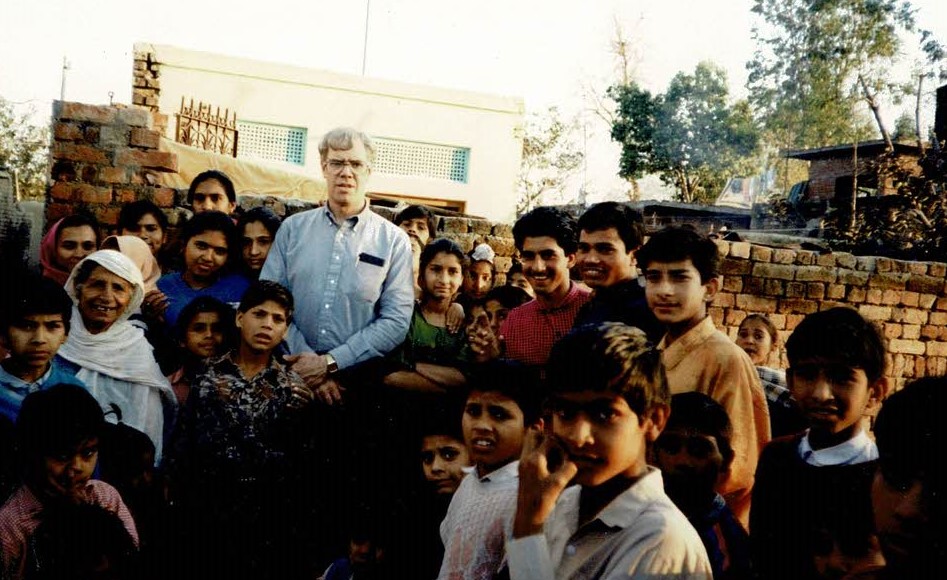 Ashwani’s neighbors blessed him for his initiative to deliver joy to an ordinary day. As for the “Englishman,” he was having an out-of-body experience. Every household fed me. Ashwani offered milk, a food I had been warned to avoid, but it arrived in a gleaming stainless steel tumbler, sweet and pure and delicious. These rural villagers on the outskirts of Batala provided astonishing hospitality to a stranger. To recount it in detail would overrun my readers’ patience, perhaps.

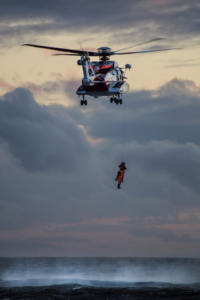 We’ve received much from God. Ephesians 1:3-14 lists multiple benefits God has granted us in Christ: election, predestination, adoption, redemption, forgiveness, and more. And as the writer lists these blessings, he interrupts himself three times with an intriguing phrase: “to the praise of the glory of His grace” (v 6); “to the praise of His glory (v 12); “to the praise of His glory” (v 14).
 Their troubles began at the taxi stand. A single car could not accommodate them and their luggage. So her husband put her and the baby and half the luggage in a taxi and said, “I’ll be right behind you in the next taxi.”
 Valerie and June agreed to stay with the baggage and be on the lookout for anyone who appeared like he was looking for someone. I went back in and begged a piece of paper, a marker and some tape. The woman wrote her name on the paper and we taped it to the handlebars of the stroller.
 both. The significance of that was not immediately obvious. But in a moment, it washed over both of us with perfect clarity and sudden joy. Because at the very tip of that island, right where the lanes parted, a man was standing, scanning all the traffic very intensely. She gasped, and I knew we had our man.